Wednesday, September 14, 2011

From Trees to Fruits and finally to Tastes!

As I go on admiring our ancestors' zeal in preserving our language so far away from our mainland,
I chew on and examine the some words we use which probably is still used in Standard Mararthi.
Here I examine the words we so commonly used for trees going on to its parts and ending with the
taste of its fruits. Hope all you readers find this as interesting as I do!

Jhaad.. झाड for Tree


Vel .. वेल for Creeper


Jhudpa ..झुड्पा  for Bush

Gavat .. गवत for Grass


Paanta ..पांटा for Branch


 Kaadi ..काडी for Twigs


Paan... पान for Leaf


Phula...फुला for Flower


Pandu ..पंडू for Fruit


Saalpat ..सालपट  for Skin of Fruit

Magass ..  मगस for flesh of the Fruit

Bihin ..भिं for Seed


Paankoli ..पांकोली for Segment of Fruit


Ras.  .रस for Juice

Magass ..  मगस for flesh of the Fruit

Naar ... नार for Fibre ( was this derived from Tamil? I wonder!)


Koula ...कौला for Tender (fruit or vegetable)

Nibbar .. निब्बर for Stringy and tough (vegetables)

Kayi ... कायी for Raw (Under ripe)

Pikalthe... पिक्लथे for Ripened.

Now Tastes!

Khaarat.. खारट ..Salty

Ambat... अंबट..Sour

Gulcheet .. गुलचीट ..Sweet  (This is peculiar to only TMD . Standard Marathi uses Goad or Meetha.)

 Probably derived from "Gul" which is sweet. So "Gulchi" was made of Gul !)

Thurat.. तुरट .. Astringent  ( Like Jhaambla (  झाम्बला) and even pomegranate is Thurat astringent)


Thikhat .. तिखट ..Spicy

Kadu... कडू ..Bitter

Sappak ... सप्पक ..Tasting Bland

and finally this is the mild allergic reaction that occurs with eating of certain fruits and vegetables...

Khavatha ... खवता ... causing itchiness in throat and mouth. Some vegetables like elephant yam can
cause khavna in throat.


Monday, August 29, 2011

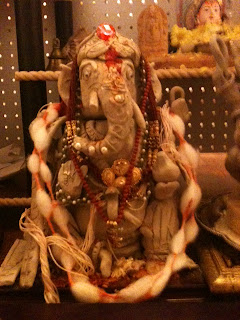
Making a Ganapathi/ganesh Idol with clay.....


 TMDs always celebrate Ganesh Chaturthi with great pomp and splendor. Why not, after all Ganapathi
with his huge ears and long trunk is the in the form of a favorite animal...Elephant! Ganapathi in every
TMD home is a favorite visitor, loving modak and laadoos!
Another factor that adds interest to this festival is the buying of a new clay idol each year;
we bring him home with a 'mangalaarathi' and seat him in the 'devghar'. With equal fanfare is he also
sent away at the end of the puja. With bells ringing, we take him outside to do the 'visarjan'.

Here, in USA and other places out of India, we find it difficult to find an idol of clay that we can
do'visarjan' also. My solution to this has been make my own tiny clay Ganesha and do the visarjan.

Here is the method....

Here's how to make Ganesha from clay.

YOU WILL NEED:

1) Please buy clay making sure it is soft and mouldable. Amaco is good so are a few others....but do
ask to open the pack and check that it is soft....

2) Wooden skewers will be required..or chopsticks. Also a  few toothpicks. 2 aritificial flowers
Some decorative beads, zari, glitters etc.

3) Next spread a plastic sheet on a large working area.
Have ready  the 'phaat' on which you will place Ganesha.

4) Now you are all set to start....

METHOD:

Take some clay, knead it a little and shape like a rectangle. this is the clay 'phaat', your Ganesha will
sit on.
Place this on the wooden plank (or whatever phaat) you have ready.

 LOWER BODY: Next, take enough clay to make a ball shape in the size of a tennis ball.
Knead this a little so it is easy to shape.
Now make a round ball out of this and place on the clay rectangle.

UPPER BODY/TORSO: Now repeat the above process ONLY THE SIZE of the ball should be about
half or 3/4 the size of the first ball  you just made.

UPPER AND LOWER BODY : Place this second ball on the first one and with slightly wet fingers,
shape like the torso (upper body) of Ganesha. While doing this shape you will be JOINING the
two rounds together to form a upper and lower body of Ganesha.
Lower body will be a liitle bigger than upper body with a big stomach. If stomach looks too small
add patches of clay and make it protrude. All the while shape with moist fingers, so that no cracks
are visible.

LEGS:
Take enough clay and make two thick legs and feet. The upper leg /thigh shd be thick enough in
symmetry to the body of Ganesha.
Attach the legs to the back of Ganesha and once again mould with wet fingers. At the back, in the
center of where u attached the two legs, add a strip of clay like a 'kaccha' You would have placed
the legs like"sitting like Ganesha'.' Ganeshaaska baslaahe' गणेशास्का बस्लाहे

HANDS:
make two long shapes to shape the hands. Attach the thicker part of the hands to the top of the
second ball( the torso) on both sides..
Bring the hands to the front and and attach the upper part of the arms to the body of Ganesha.
The lower part of the arm will stand alone  (attached at the upper arm). \

SHAPE PALMS:
Shape the palm...one in a blessing posture and the other holding a laadoo or modak.

TRUNK AND HEAD:
Take clay about enough for a little bigger than tennis ball. Knead very well.
Make a round slightly longish in front
Now start shaping a short trunk to the face.
Shape ears.
Now with wet fingers, smooth the shape you have made.

ATTACHING HEAD:
Poke the skewer on to the body of Ganesha on top of the upper body. this will be on top of
where you have attached both the hands.
Place the head on to the skewer. (Make sure ur skewr is cut to the right size...it should not peek out!)
With wet fingers ease out and shape the attached neck..so no lines are visible.and it looks one piece.

TWO MORE HANDS:
Cut a skewer to 1/3. Shape the second pair of hands...just a short longish roll and poke the skewer
on the thicker part of the hands and attach with the skewer to the back of the upper body(in the back)
Repeat on other side.
Place the artificial flower in each hand.

TUSKS:
Snip off apiece of toothpick and roll some clay around and poke and place as tusks on both sides.

SNAKE:
Be sure to shape a long long snake and tie around Ganesha's waist.

CROWN:
Shape any type of crown...

MOUSE:
Shape a body, pointy face, 4 legs, and a tail!

EYES:
Place two clay dots and two lines as eyebrows..and paint black after a little dry.

Decorate Ganesha with clay or decorative beads, zari etc.   bangles, earrings, painjan, decorate his
trunk and crown or even with just a toothpick.
Add a paper panche and anga vastra. do all this while clay is still wet.


After puja,  Ganesha comes alive, you feel He is smiling!

Thursday, August 11, 2011

A humble attempt at a Thanjavur Marathi Poem on VaraMahalakshmi...

VARAMAHALAKSHMI

Nava gajaacha Hirva lugda nesingu,
Kaanantha vajraacha thoda
Thamda khadecha Mukhra
Padmapatraaska dolantha kaajal bharun
Kapaali laamb kunku jhalkath
Haathanth bharun sonyacha kaankan
Galaantha kaasacha maala, Mothecha maala
pavalacha maal  sajivuna
yethi amcha Mahalakshmi.

Thija painjan karta chan chan chan
Gharaantha payen thivthaansu
Gharaantha bharta Navaratna
Sonyaacha paoos phadtha
Chan chan chan paula gheyun
Ghara aantha yethi amcha Mahalakshmi.

Mahalakshmila thija Narayana kada Basiva,
Phulaacha maala ghalun sajiva
Phula ani  patra ghalun archana kara
kheer waran puran poli
khadi ambode kosumbaricha
Neividya kara

Smaran kara Sree Lakshmi baslihe
Thija Narayana shedari
paalka maandi ghalingun
naazuka haathana jevthi
thumi karlethe laadoo cha roocha ghethi
Vidaacha paananth vela ghalun, supari ghalun
sakhar ghalun vida ghethi
Santosh jhaali amcha Mahalakshmi

"Mahalakshmi, amcha rakhsa kara"

 नौ  गजाच हिरवा लुगडा  नेसिंगु
कानान्था  वज्राचा तोड़
थमडा  खडेच मुख्रा
पद्मापत्रास्का डोलेन्था  काजल  भरून
 कपाली लांब  कुंकू झलकत
हाथ भरून सोन्याचा कंकण कांकण
गळांन्थ  कासेच माळा, मोतेचा  माळा 
पौलीचा माळा सजीवूणु
येती अमचा महालक्ष्मी 

तीजा पैंजण करता छन छन छन
घरांत पायें ठिव्थान्सू
घरांत भरता नवरत्न
सोन्याचा पावूस पढता
छन छन छन पौला घेउन
घरान्था येती आमचा महालक्ष्मी

महालाक्ष्मिला तीजा नारायणा कड़ा बसिवा
फुलाचा माल घालून सजीवा
फुला अणि पत्र घालून अर्चना करा
खीर वरण पूरण पोली
कड़ी आम्बोड़े कोसुम्बरिचा
नैविद्य करा

स्मरण करा श्री लक्ष्मी बस्लिहे
तीजा नारायणा शेदारी
पालका मांडी घालिंगुन
नाज़ुक हाथाना जेवथी
तुमी करलेता लाडूचा रूच घेती
विडाचा पानान्था  वेला घालून सुपारी घालून
साखर घालून विदा घेती
संतोष झाली आमचा महालक्ष्मी

महालक्ष्मी, अमच रक्षा करा !


Monday, May 9, 2011

Amhi Thanjavur Marathi

Vyankoji aale Thanjavur
Jhaalon amhi Thanjavurche
 Amhi aahon Deshestha Marathi
Amcha bhaasha Thanjavur Marathi

Sana Vaara Munji Waraad
Asgi amcha veghala paddath
Amba Bhavani, Renuka Devi, Vekataramana
Asthaath amcha Kuladevatha

Nestho amhi Kaasota
Ghaalingtho amhi Mukhra
Bolthon amhi Marathi

Thanjavur Marathi

Jevan amcha sambar, saar ,pitla, kadhi
Kheer, ambode, puranpoli
Pana nahi karton "Amti"
Amhi Thanjavur Marathi!

व्यंकोजी आले तंजावूर
झालो अम्ही तंजावूरचे
अम्ही आहोन देशेस्थ मराठी
आम्चा भाषा तंजावूर मराठी

सन वार मुंजी वराड
अस्गी आम्चा वेघला पद्दत
अंबा भवानी रेणुका देवी वेंकटरमणा
अस्ताथ आम्चा कुलदेवता

नेस्तहो अम्ही कासोटा
घालीन्गत्हो अम्ही मुख्रा
बोल्तोन  अम्ही मराठी
तंजावूर मराठी

जेवण आम्चा सांबर सार कढी पिटला
खीर अम्बोडे पुरणपोळी
पण नही कर्तोन "आमटी"
अम्ही तंजावूर मराठी


Tuesday, March 22, 2011

A Thanjavur Marathi Heritage House .

I had the unique opportunity of visiting my sister's relative in Thanjavur and their home preserved
with all its decor from the ancient times. This house I learn is over 200 years old.  I was thrilled to see
such a place and wished I could have taken more pictures but I really could not keep clicking away
pictures inside the house of people I barely knew!
However here are a few pictures I did take......


1) This was a sort of Dev Ghar soon as we entered. Don't miss the beautiful ancient Thanjavur Paintings!
I heard that the family who used to live here arranged their Navaratri Kolu in front of this. And to this
date is a "Kunt" (temple tank) shaped in the floor in front of this 'Dev ghar' !The "Laandra" ( lantern)
that are seen hanging from the ceiling are a thing from the past indeed!


2) A lot of homes in those days had a "chopala" ( a large swing) where the lady or man of the house
would take his afternoon siesta. Here is a picture of the " chopala" in this house.


3) This is indeed a rare "Tulsi Brindavan" . Made of copper with engraved design , it is one of a kind .
Kudos to the people who preserved this peice!  This was in the 'angan'(courtyard) of the house


Thursday, February 3, 2011

On Rain..........

We have so many words connected with Rain.... I thought it is worth a blog post!

 Paous... पावूस  is Rain

Sinthode.. सिंथोडे are Raindrops

Vasaadey ..वसाडे  is the misty shower

Vaara-Paous .. वारा -पावूस is a storm/cyclone
(actually means wind and rain)

On this note...here's a rhyme..

PAUSA PAUSA PAUSA
THULA EK PAISA
THOOPAANTHA PHADLA MAASHA
____LA NAHI MEESHA!

Wednesday, January 12, 2011

Rarely Used/ Some Forgotten Thanjavur Marathi Words and Phrases

Even though these words are frequently used by many TMDs ,  I rarely hear these words from the younger and upcoming generation. English is used for all these words and slowly our language is getting dissolved. How many times do we really use 'KHOLI' when talking to our kids. Most of the time we say  'ROOM'! ot "kamra"

It is true that TMDs living in TamilNadu are still able to maintain and preserve our Marathi but those outside Tamil Nadu , even Bangalore slowly begin to use the local terms! Therefore I address these common words as Rarely Used. By Rarely Used I mean outside of our mainland, Tamil Nadu!

KHOLI
खोली
Room


THUJA DHOMLA!थुजा ढोमला) is used as a mild scolding!DHOMLA / DHOI used for DOSKA (Head)
ढोमला /  ढोई for  डोस्का


MAAKU GHALNA
माकू घालणा
Giving an Oil Bath.

BAHUSHA
बहुशा
Probably
Hey vaara pausaanth bahusha thene usheeraan yethila
हे वारा पौसांथ बहुशा त्हेने उशीरान  एथीला 
In this storm(wind and rain) they will probably be late(usheer)

AKASMAATH
अकस्माथ
Suddenly
baaher jaathana akasmath majha bhau bhaujala bhetlon.
बाहेर जाथाना अकस्माथ मझा भाऊ भौजाला भेंटलों 

When going out we suddenly met my brother and his wife

YADESHTA
यदेष्ट
More Than Enough
thyajha kada yadeshta paise kaas ahen
थेह्जा कडा यादेष्ट पैसे कास आहे    
He has more than enough of money 

NISSANGA 
निस्संग 
STRAIGHT
SAAVALI
सावली 
DUSKY COMPLEXIONED

KATHAAD
काथाड
SKIN
VARAVANTA
वरवंटा 
GRINDING STONE

GHOONS
घूंस 
BANDICOOT


Wednesday, December 29, 2010

People and Professions

Here's a list of TM words for people according to their professions. Some of these are used widely among TMDs even today but some have become obsolete.

While on the subject of professions, SALARY in TMD is called MUSHARA (मुशेरा)
and NO WORK  (free time) is called RIKAAM  (रिकाम)

NAADI PHANAR ( नाडी पहाणार)
DOCTOR
Later on a doctor came to be called as VAIDYA ( वैद्य)

PANTHOJI (पंथोजी)
TEACHER

SHIMPI (शिंपी)
TAILOR

GUMASTHA ( गुमास्था)
CLERK

SAMPAAKI (स्वम्पाकी) 
COOK


 SONAAR ( सोनार)
GOLDSMITH

SUTAAR (सुतार)
CARPENTAR


HAJAAM(हजाम)**
BARBER **
** Not sure if this is a true Thanjavur Marathi word or Urdu. This was used by my grandmother.


PEEKOR (पीकोर)
DRUNKARD


CHAAMBHAR (चांभर)
COBBLER

KUMBHAR (कुंभर)
POTTER


NAACHNAR (नाचणार)
ACTOR/ DANCER


VAKIL (वकील)
LAWYER


ROGISHTA (रोगिष्ट)
PATIENT/ SICK PERSON


PHULA VIKNAARI ( फुला विकणारी)
FLOWER SELLER (Female)


BHAJI VIKNAAR  (भाजी विकणार)
VEGETABLE VENDOR (Male)


HANKNAAR (हन्कणार)
DRIVER


GAADI HANKNAAR ( हन्कणार)
CAR  DRIVER 

VYAPAARI (व्यापारी)
BUSINESSMAN (doing buying and selling)


VYAVASTHA (व्यवस्था)
 OCCUPATION

Monday, December 13, 2010

Forgotten Thanjavur Marathi Words...(3)

More of the forgotten Thanjavur Marathi words....

NARVATTI
नरवट्टी   
Meaning: COCONUT SHELL
A coconut shell was called  Narvatti.
In ancient times this had several uses...
1) Was used as a cup
2) To serve salt.
3) Was used as a ladle with a wood handle fixed, to serve Dahi/curds


EK NAADI
एक नाडी
Meaning: ONE MINUTE

SEEVAN
सिवण
Meaning: STITCHES
TO STITCH would be SIVAN GHALE सिवण घाले


KUNAAVNA
कुनाव्णा 
Meaning: TO GESTURE OR SIGNAL  


The few below are still used by some people and have not been forgotten as much.

PHANI
फणी
Meaning: COMB

VINCHARA
विंचर
Meaning: TO COMB (verb)

It is odd that the hair brush or comb is called 'Phani' and the act of combing called something totally different sounding as in 'vinchara'.

DAVA HAATH
डवा हाथ
Meaning: LEFT HAND
Similarly DAVA PATEES  डवा पटीस would mean LEFT SIDE (PATEES meaning SIDE)

UJVA HAATH
उजवा हाथ
Meaning: RIGHT HAND
UJVA PATEES   उजवा पटीस   is RIGHT SIDE


Friday, December 3, 2010

BHARITH...a Thanjavur Marathi Dish

 Bharith is a very tasty accompaniment to any meal and very simple and easy to make.No grinding and no masala!
What makes Bharith different from Raitha? As far as I know, Bharith is  made with mashed vegetable and raitha is made with grated or chopped vegetables. It is not equivalent to the Tamil  'thogayal' as this is largely made with Dahi/ Curds.

BHOMPLAACH BHARIT:
Interesting Info: I hear that in my grandfather's time tender whole pumpkins were roasted on coals
until the skin was charred. The skin would then be removed and the pulp of the pumpkin mashed to make Bharith!
This was probably done in the 'CHUL' used to heat water for bath . Probably the younger generation have no clue about all this....will blog about it another time...

Anyhow, in today's Thanjavur Deshastha homes, the pumpkin or bhompla is peeled, chopped, boiled and the mashed.
To this is added 'phodni' (this has come to be referred as 'ponni' in TMD homes!) .
To make 'phodni'..heat oil, add mustard seeds, udadcha dal, thamda mirsinga(red chilli). Once udad cha dal is brown, add  hirva mirsinga (green chilli), karepak (curry leaves) and add to the mashed bhompla/pumpkin. Mix with dahi/curds and garnish with kothmir. Add salt.

VAANGYACHA BHARIT:
Made with the huge big vaangi/brinjal/eggplant this is made the roasted way. Roasted on fire, peeled, mashed and made just same way as above.

URLAGADDE/BATATA CHA BHARIT:
This ia also made by boiling the potatoes and mashing them. Phodni of red chillies, udadacha dal, mohre(mustard seeds) is added , along with green chillies, curry leaves. This is mixed with dahi/curd and garnished with kothmir.

Monday, November 29, 2010

Interesting take on Colours and Metals in Thanjavur Marathi!

Common colours in Thanjavur Marathi .....

Colours are called ..."RUNG"  "रंग"
Is it possible that this was derived  from Urdu? Who knows!

For a colorful design , a 'kolam' or 'rangoli', the TM word is " RAANGOLI" ,"रांगोळी"
This looks more original, note the elongated 'aa' sound and the unmatched 'ळ' !

All of us must have heard of the " RAANGOLICHA DABBA"  (The box containing the "RAANGOLICHA PUUD" (rangoli powder)


Now for the colours...

THAMDA... RED


HIRVA.... GREEN


NEELA...  BLUE


PIYULA...YELLOW


KAALA...BLACK


PHANDRA....WHITE

NAARANGI.... ORANGE 

JHAAMBLA...PURPLE

As the above indicates, the rest of the colours were identified with fruits or vegetables. Like Jhaambla is the kala jamun fruit that is purple in colour. 
So then you have,

VANNGYACHA RANG

KAANDECHA RANG and so on..

Now for the Metals....

SONA...for  GOLD

ROOPA ... for  SILVER

Interesting input from one of our followers, Divya  is... THAMBOOSA ..for  COPPER. Also called
"THAMRA"

PITTHAL  ...for BRASS

LOKHAND ...for IRON

KAANSE....for  BELL METAL ( an alloy vessel of this Kaanse was used to make saar)

 SHISE  ... for LEAD 

Monday, November 22, 2010

Forgotten Thanjavur Marathi Words...(2)

More of forgotten words....

Gharosa / घरोसा  ..  Cobweb
कोनांत घरोसा बांधू गेला आहे   ... There are cobwebs in the corner

Komat / कोमट  ... Lukewarm
Himaala/ हिमाला ...Cold Weather/Winter
हिमालांथ कोमट पाणी पिणा चकोट... It is good to drink lukewarm water during winter.


Dhirda/ धिरड ..   Dosa

Sarvasadharan/ सर्वसाधारण ..  Ordinary
घर बांधना काहीं सर्वसाधारण  काम नोहो... Building a house is not an ordinary job!

Khede Gaanvखेडे गांव ...Village
त्हीना खेडे गांवान्त्सू आली आहे .. She has come from a village.


Anthakarna अन्थकर्ण.. Affection
थीला सावत्र लोन्कावर काहीं अन्थाकर्ण नाहीं... She has no affection for her stepson.

Ek Haath/ एक हाथ... Measurement for One Cubit

Gaj/ गज...for yard measurement
नौ गजाच लुगडा ...Nine yards Saree

Numbers....

Numbers 1 to 20 are.......

ek, dona , theena, chaara , paanch saha, saatha, aatha, nou ,daha, akhra, bhara, thera, choudha, pandhra, soula, sathra, athra, ekunavees,  vees

Numbers 21 to 30 are....

ekevees, baavees, thevees, chouvees, panchivees, souvees, sattavees, attavees, ekunathees, thees

30 ..Thees

31..Ekethees

32...Bathees

33.. Thethees

34... Chouthees and so on similar to 20 or Vees...  till 40

40...Chaalis

41..42..43  are all like ekechaales, bachalees, thechalees and so on

50 ...Pannaas

60 ...Saat


70...Sattar

80..Ainsi

90...Navvad

100..Shambhar

Idioms and Phrases in Thanjavur Marathi (2)

As we continue some idioms and phrases used in Thanjavur Marathi...here are a few more...

Jeev Laamb
जीव लांब
Meaning: Long Tongue
Much used to refer to 'developed taste buds'! A person who likes good food prepared with a lot of effort and care is referred to as having 'jeev laamb' . Used fondly sometimes and sometimes in irritation of having to put in the effort!


Aho Ralleka!
अहो रल्लेका!
Meaning: Mr. Scoundrel
This oxymoron that dates back to my great grandmother and expresses so much in just two words!. 'Ralleka'  is commonly used to mean 'Idiot', 'Cheat', 'scoundrel' and what have you.
'Aho' is a term of respect and is used to address someone respectfully.  How did these two opposites get to be used in one breath?
When someone treats another in outward show of respect but means total disrespect and insult, it is referred as treating like 'aho ralleka' !


"Dharana Basna"
"धरण बसना "
Meaning:  Sitting in Wait
This idiom or phrase is used when a person hovers over someone doing his work. The hovering may hinder the working person and make him slow. and less responsive.


"PotJhaal"
"पोट झाल"
Meaning: Stomach burning
Being Jealous is called ' "potjhaal"


"Dhaandga Bokka"
"धांडगा  बोक्का"
Meaning: Fat Strong
A fat huge person is called Dhaandga Bokka.


"Gharoghar"
"घरोघर"
Meaning: House to house.
Going from one house to another is called gharoghar.


"Pahthera Manush"
"पाह्थेरा मनुष "
 Meaning: Reliable person
A trustworthy person , very reliable is called Pahthera manush.


Wednesday, November 17, 2010

More Proverbs...(3)

 Here are some more Thanjavur Marathi Proverbs....
 
"Kela aanth Suin Tonchlaska"
"केलांथ सुईन टोंच्लासका" 
Meaning: Like piercing a Needle into a Banana 
Various meanings come forth for this proverb. However all of them reference the exact meaning of this proverb...a needle will pierce into a banana very easily without any obstruction so influencing someone quietly without the person realizing it could be one meaning of this proverb.This has both positive and negative connotations.


"Chorta Phadlathe Gharaanth Thel Dhand"
"चोरटा पडलाथे  घरांथ थेल ढंड "
Meaning: Oil wasted on a house that has been looted.
Why waste oil in the  lamp to see what has been lost!
why waste more money after what has been lost


" Ek Haathana Thaali Vaazath Nahi"
"एक हाथाना  थाली वाज़थ नहीं"
Meaning: You cannot clap with one hand.
It takes two to fight or to compromise. A fight or a compromise cannot be met with just one person's effort. It takes two to fight or to compromise.


" Hontaanth Ek Potaanth Ek"
"होंट आंथ एक, पोटांथ एक "
Meaning: What is on the lips is not in the stomach
Saying something but thinking and feeling something else that is opposite. With reference to people who say nice things to others but harbor a lot of ill will towards them.


"Paanch bota Ek Saarka Asnaar Nahi"
"पांच बोटं एक सार्क असणार नही"
Meaning: Five fingers will never be similar.
Just like our five fingers are never similar there will be diversity and dissimilarity among several of a kind.

" Ek Damdi Kaas Nahi"
"एक दमडी कास नही "
Meaning: Does not have a copper cent on him.
Very poor. So poor that he does not possess even a cent .However, this proverb simple as it sounds is used
in a derogatory fashion. While scorning someone given to flamboyance and show off, it is common to say , "Ek damdi kaas nahi, jamb daakhivto" एक  दमडी  कास  नही , जंब  दाखीवतो. He does not have a copper, but shows off.

Tuesday, November 9, 2010

Thanjavur Marathi Deshastha...a Heritage. Keep it Alive. Preserve it!

Dear Readers,

While talking to my sister's neighbor in Pune, I came to know that our Thanjavur Marathi was Ancient Marathi.
This person is a professor and is currently involved in creating a Marathi-English dictionary . Referring to words like "KIVAAD" for DOOR, he said that in ancient times this was the Marathi spoken and they DID refer to DOOR as KIVAAD and not DAAR as is done in Standard Marathi .

While we explore  this theory and find out more, let us all try and keep this language alive. Let this so well preserved language and culture not slip into oblivion. I appeal to Thanjavur Marathi Deshesthas of all generations, to help in making this a spoken recognized language.
Speak the Language ..at home . Try not to substitute with English words when speaking...difficult but give it a shot!
Make your TO-DO lists and grocery lists in Thanjavur Marathi....believe me, its fun!
I did do the grocery list in TM and had fun with 'Thaandulaach peeth' and 'Mirsingaach pud'
Have fun folks and let me know about your adventures!

Monday, November 1, 2010

Proverbs in Thanjavur Marathi (2)

While on a quest for idioms and proverbs preserved among the TMDs, sad to say, not many are in use today. The influx of English over Marathi as a means of communication and intermarriages with Kannada speaking Deshasthas has allowed a slow death of these precious gems of any language.

Proverbs and idioms or Sayings give strength to a language and in a language so preserved over generations, it helps to enhance the language  to a level of recognition as a dialect of the Mother Language- Standard Marathi.

While I still continue my search for more of such proverbs and sayings, which I shall add periodically, here are some...


"Chorta la vinchu chaavlaska"
"चोरटाला विंचू चाव्लेस्का "
Meaning: Like a thief getting bitten by a scorpion
This saying is used to describe....
Getting stuck when doing something wrong or illegal but cannot call for help as they would be caught in the wrong or illegal act!
A thief when in the process of robbing a house gets bitten by a scorpion, he cannot call for help as he would be caught for burglary!


"Goricha gorapan diwas ujaltra kallal"
"गोरीच गोरापण दिवस उगल्त्र कलेल "
Meaning: A fair complexioned girl's fairness will be known when it is daylight/morning. Perhaps this means something like "the proof of the pudding is in the eating"


"Nitya ganda purna ayisha"
"नित्य गंड पूर्ण आयुष"
Meaning: Sick everyday but living a full life term. This is used for people who complain about some illness or the other everyday, yet have a full life expectancy and  live to a ripe old age


"Undirala Manzar Saakshi"
" उन्दिराला मांझर साक्षी "
Meaning: Cat as witness to the Mouse .
Having an enemy as a witness does not help.

"Potaavar Maaruka, Paathivar Maara" 
 " पोटावर मारुका पाठीवर मारा "
 Meaning: Do not hit on the stomach, hit on the back.
Here 'stomach' refers to 'livelihood' . A beating on the back is better than taking away a livelihood.


More in my next post....


Wednesday, October 27, 2010

Idioms and Phrases in Thanjavur Marathi (1)

Thanjavur Marathi is rich in idioms and phrases. A lot of phrases are used in common everyday language freely. On studying this preserved language one wonders at the richness of this language conserved with all its idioms!
I humbly present a few of the idioms used and hope to hear of more from my readers...

खपट नही ...  KHAPAT NAHI
An innocent person is described so. A person who is not street smart and does not know the ways of the world.

घान्तोड बांध ...GHAANTOD BANDHA
Pack off. That is what this phrase means. As explained by its meaning "pack off" this phrase is used negatively. Pack off and leave.
Exact Meaning: Tie a bundle. Probably derived from ancient days when people tied a bundle of clothes and necessities to travel.
Example: मी  कराच संपाक आवड्नात्र घान्तोड बांध . If you don't like my cooking, pack off!


चाडी सांगणा ...CHAADI SANGNA
Telling tales about somebody...squealing about somebody.


हाथ राखण ...HAATH RAAKHAN
Stand By for a rainy day or when needed. As in when going shopping we keep by some extra money just in case it is needed...Haath Rakhan asunde.

हाथ लांब ...HAATH LAAMB
This idiom has two uses:
1) A person who is given to stealing small things is referred to as Haath Laamb. It is used as in
जत्तन,  थीला हाथ लांब....Be careful, she is given to stealing.
2) Raising hand in beating or slapping easily. Used as in...
लेन्क्रावर सदा हाथ लांब करुको...Don't raise your hand on the child so much.

Hope you enjoyed these.... More later.

DID YOU KNOW:

A DOCTOR in TMD is called ' NAADI PHANAR'
NAADI PHANAR literally means ' One who sees pulse'

Thursday, October 14, 2010

Days and Months..

Here's how TMDs call the Days of the week...

SOMVAAR   ............   SUNDAY
MANGALVAAR. ....    TUESDAY
BUDHVAAR     .......    WEDNESDAY
GURUVAAR  .............  THURSDAY
SHUKRAVAAR ........   FRIDAY
SHANIVAAR .............  SATURDAY
AITHVAAR     ............  SUNDAY

Months in the Marathi(TMD) calendar are....

Please note our calendar begins from Gudicha Phadwa which comes around March....
Always in the Marathi calendar, the new month begins on the PHADWA after AMAVASYA.
Each Month is known for certain festivities, which I have listed next to the month.

CHAITRA MAAS.......... Gudi Phadwa, Chaitra Gauri from Gauri teej, Chaitra Navaratri , Ram Navami and Hanumath Jayanthi

VAISHAAK MAAS......   . Akshaya Thrithiya and Narasimha Jayanthi

JYESHTA MAAS .....         Vata Savitri Purnima

AASHAAD MAAS .....       Chaaturmaas Vrat begins

SHRAAVAN MAAS ....      Thaanvicha Amavasya, Mangala Gowri Puja, Naga Chaturthi, Naga Panchami, Varmalakshmi,  Shraavani, Sri Krishna Janmashtami and besides this is the Sampath Shukravaar and Shravan Shanivaar on all Fridays and Saturdays of this month.

BHADRAPADA MAAS ....    Swarna Gowri Vrata , Hartalika and Ganesh Chaturthi, Rishi Panchami and Anantha Chaturdashi,  Paksha Maas

ASHWIN MAAS ....   Mahalaya Amavashya, Navaratri with Saraswathi Puja, Durgashtami, Maha Navami and Vijaya Dashami

KARTHIK MAAS .... Deepavali/Naraka chaturdashi, Bali Padyami, Bhau beej, Uttana Dwadashi

MARGASHIRA MAAS ...

PUSHYA MAAS ..Vaikunta Ekadashi, Bhogi, Shankranthi

MAGHA MAAS ...Rathasaptami, MahaShivaratri

PHALGUNA MAAS ... Holi

Thursday, October 7, 2010

Forgotten Thanjavur Marathi Words...(1)

 With the predominance of English and with more and  more TMDs migrating out of Thanjavur and surrounding areas, intermarriages and with the younger generation speaking more of the local language, Thanjavur Marathi so well preserved in spite of a cultural onslaught of Tamil is being less and less spoken. Even as I write this, I can recall so many words which my grandmother used and we don't use at all.
So here is a post on Forgotten Thanjavur Marathi words.....

Readers, please contribute words from your own memory and let us rekindle this language into a spoken recognized one!


पंथोजी...PANTHOJI   ... for Teacher

उन्सीचा घौसन... UNSICHA GHOUSAN....for Pillow Cover

त्हूप केला... THOOP KELA ...for Guava (fruit)

गाई घुर..GAAI GHUR... for Cow Shed

अवळे ...AVALE ...for Starberry (Nellikai)

पांग्रून   or पासोडी...PAANGRUN or PAASODI   ...for Bedsheet Cover, Comforter

पान्ग्रीवे ..PAANGRIVEY ...To Cover

खडे घेण...KHADE GHENA...To Carry on Hip

as in... लेन्क्राला खडे घेटले...Lenkrala Khade Ghetle...Carried the Child On one's Hips

पिसिवी...PISIVI... for Bag

साळ ...SAALA...for School  .  As in साळेला गेलिस्का ..Saalela Geliska...Did you go to school?

मुशैरा...MUSHARA....Salary

संपाक खोली ..SAMPAAK KHOLI...Kitchen

गुमास्था...GUMAASTHA...for Clerk

डुकरा..DUKRA...Pig

ढेइंकून ..DHENKUN...for Bed bug

रिकाम...RIKAAM...No Work/ Free Time

इशोभ..ISHOBH...for Maths, Calculate...

परची ..PARCHI ...for Bill

अंगी..ANGI ...for Dress, Frock

अंथरुण..ANTHRUN...for Bedding/Mattress

पलंग..PALANG...Cot, Bed

वंग्ला..VANGLA...Wicked Fellow. ( A wicked woman would be called...Vangli वंगली)

घाणटोड ...GHAANTOD...Bundle